

- A new Bybit report found that some blockchains have native mechanisms allowing them to freeze crypto assets.
- The exchange said that such features contradict the decentralized and censorship-resistant ethos of crypto.
Decentralization and censorship resistance are among the key narratives that elevate the appeal and drive demand for cryptocurrencies. They uphold the foundational promise of Bitcoin (BTC): to enable peer-to-peer transactions without fear of intervention from central authorities, such as governments and financial institutions.
This expectation of financial freedom is what makes crypto revolutionary. However, Bybit’s Lazarus Security Lab recently exposed that several blockchains have embedded freeze mechanisms in their native infrastructure, shattering their perceived trustless facade.
Blockchains with Native Asset Freeze Mechanisms
Of the 166 chains the team reviewed, it found that 16 can freeze user assets for risk mitigation. Interestingly, one of the top 10 largest cryptocurrencies by market cap operated on a network it flagged.
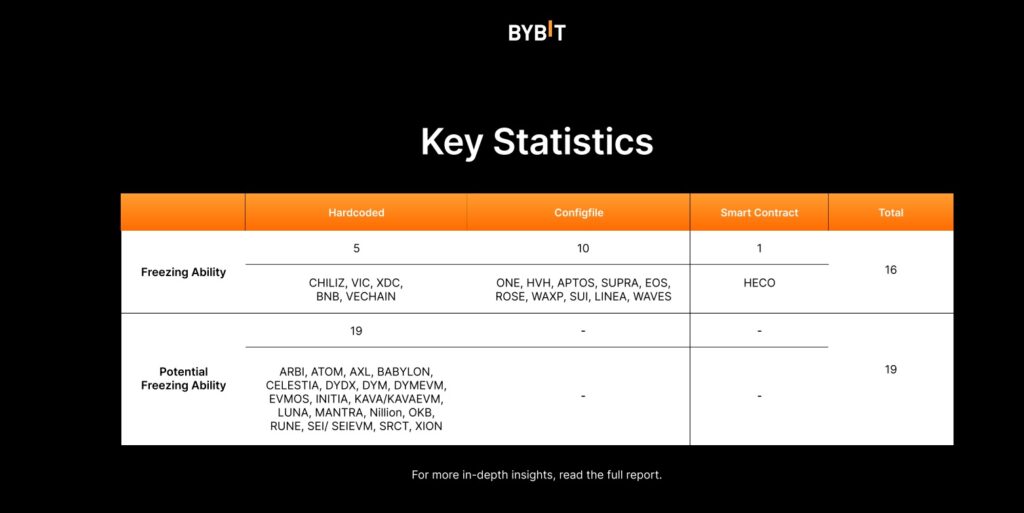
Bybit’s findings under its new report titled “Blockchain Freezing Exposed: Examine The Impact of Fund Freezing Ability in Blockchain” revealed that BNB had a hardcoded freezing mechanism, meaning the function is directly built into its blockchain code. It shared the same capability as:
- CHILIZ (CHZ)
- Viction (VIC)
- XDC
- VeChain (VET)
Meanwhile, 10 networks possessed configuration-based (Configfile) freezing, which validators or foundation settings can activate. These are:
- Harmony (ONE)
- Havah (HVH)
- APTOS (APT)
- SUPRA
- EOS
- Oasis (ROSE)
- Wax (WAXP)
- SUI
- LINEA
- WAVES
Additionally, Bybit detected a smart contract function that enables asset freezing in the HECO network.
Crypto Chains With Potential Freezing Ability
Lazarus Security Lab noted that 19 others could introduce similar functions through simple protocol tweaks. These include:
- Arbitrum (ARB)
- Cosmos (ATOM)
- Axelar (AXL)
- Babylon (BABY)
- Celestia (TIA)
- DYDX
- Dymension (DYM)
- DYMEVM
- EVMOS
- Initia (INIT)
- KAVA/KAVAEVM
- Terra (LUNA)
- Mantra (OM)
- Nillion (NIL)
- OKB
- THORChain (RUNE)
- SEI/SEIEVM
- Secret (SRCT)
- XION
Bybit’s Conclusion
Bybit claimed that these measures are essential safeguards against hacking and illicit transactions. However, many users may be blindsided by the sudden realization that their crypto holdings may not be as decentralized as what their developers, issuers, or supporting foundations have led them to believe.
“The presence of these mechanisms fundamentally challenges the foundational principles of a decentralized ecosystem and necessitates further discourse within the blockchain community, but it has prevented hackers from stealing funds,” Bybit wrote in the report’s concluding statement. “The study contributes to a more transparent understanding of these capabilities, providing a foundation for future research and risk assessment in the rapidly evolving digital asset space.”
The platform notably fell victim to a crypto heist early this year, resulting in an immediate $1.5 billion loss. Law enforcement authorities only recovered a small portion of the funds after the incident.
What’s your Reaction?
+1
0

+1
0

+1
0

+1
0

+1
0

+1
0

+1
0