
Solana has had another wild year. After roaring into 2025 near its earlier highs, dropping hard, then clawing back a good chunk of those losses, it has kept traders on their toes.
As of late November 2025, Solana (SOL) trades around the mid 130s, well below its January peak near 270 to 295. But still, it’s far above its deep bear-market lows from previous years.
If you are a normal investor, not a full-time crypto trader, you probably just want a straight answer: is Solana still worth buying or holding in 2025, or has the moment passed?
In this guide, I’ll go through that question in plain English. You will see why some people are still bullish on Solana’s fast, low-cost network, and why others stay away because of volatility, outages, and uncertainty.
Let’s start!
Where Solana stands: Price, performance, hype
Solana’s 2025 chart looks anything but stable. A strong start near the highs, a sharp slide, then a partial recovery and long period of choppy prices.
In late November 2025, SOL was trading around $135 to $145, followed by another drop at the start of December that pulled SOL down to around $126.
That is a big drop from its January range near $270 to $295, which was the strongest part of the year. The move down wiped out a lot of fast gains from late 2024.
As the year went on, Solana sank from those highs to much lower levels in mid-2025. Then it stabilized and bounced a bit, and settled into the current mid-100 range. It’s still down sharply from its peak, but not at the worst levels seen during the year.
Here is a simple snapshot of 2025 so far.
| Time in 2025 | Approx. SOL Price Range | Simple takeaway |
| January highs | $270 – $295 | Euphoria, heavy hype, near peak prices |
| Mid-year slump | Low-to-mid $100s | Sharp correction, sentiment turns cautious |
| Late November 2025 | $135 – $145 | Partial recovery, still well below highs |
| Early December 2025 | ~$126 | Another downturn as volatility returns to the market |
So where does that leave you as an investor?
Well, Solana is no longer “cheap” in the sense of its old bear lows, but it’s far from its 2025 peak. That mix of distance from the highs and history of big swings is what makes SOL feel both tempting and scary at the same time.
Solana’s 2025 price action in plain English
Here is the year boiled down:
- It started strong, near its best levels ever.
- It dropped hard, losing a big chunk of value in the first half.
- It recovered partway, and now moves in a broad, choppy range around the mid 100s.
A chart like that screams volatility. That means big upside is possible, but big downside is also very real. It is not a smooth “line up and to the right”.
Analysts and traders post a wide range of price targets for 2025 and beyond. You will see cautious forecasts that keep SOL near current levels around $150. An example is CoinCodex’s Solana price prediction, which has it in the $160 to $170 range at the beginning of 2026.
But there are also highly bullish calls that imagine it above $400 or more if momentum returns.
The spread of those guesses, from about $150 to $450, shows one thing clearly.
Nobody knows for sure.
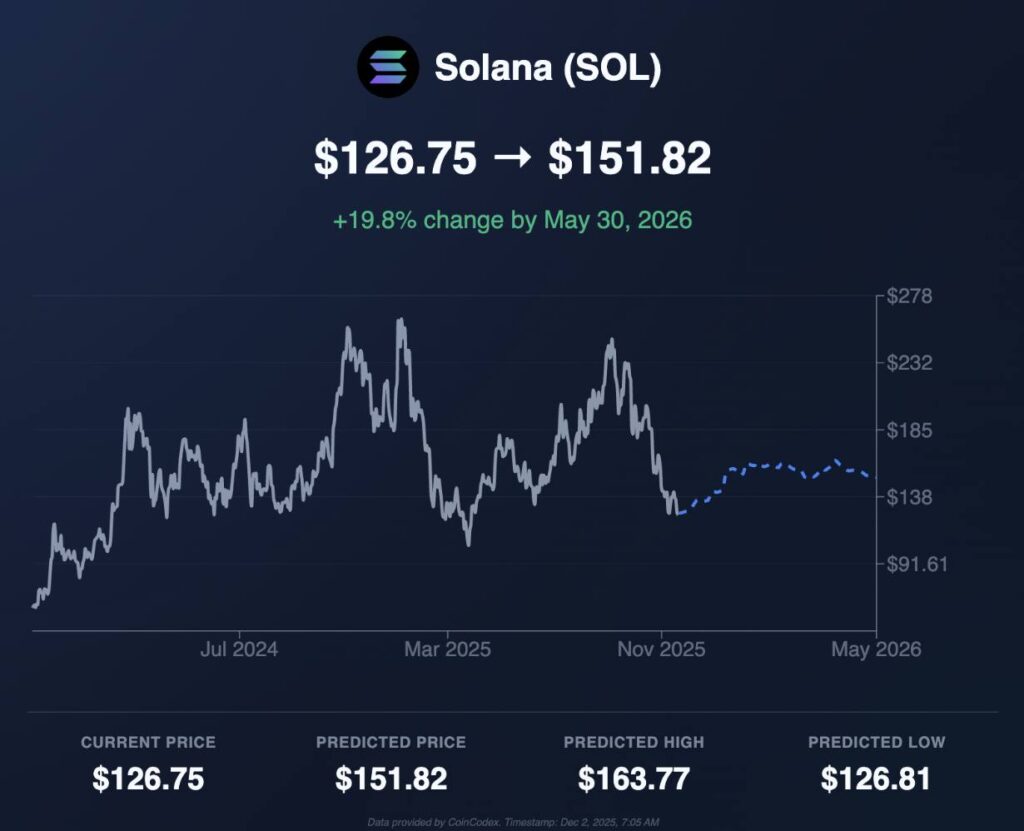
When you see any target for Solana, treat it as a story about what could happen, not a promise of what will happen.
How Solana compares to its all-time high and other coins
Solana’s early 2025 peak close to $270 to $295 put it near its best levels ever. Since then, it has dropped a lot, which leads to two common views:
- “Room to grow” view: Because SOL is well below its highs, some investors think there is plenty of upside if the next crypto bull run kicks in.
- “Warning sign” view: Others see the failure to hold those highs as a sign that a fresh record is not guaranteed, especially with so much competition.
Compared with Bitcoin and Ethereum, Solana still sits in a higher-risk, higher-reward spot:
- Bitcoin is the “bluest chip” of crypto. Lower risk than most altcoins, but also slower, steadier gains.
- Ethereum offers smart contracts and a huge app base, with more tech risk than Bitcoin, but a long track record.
- Solana aims for higher speed and lower cost than Ethereum, which gives it big upside if that bet works out, but also higher tech and market risk.
For a normal investor, that means Solana is still relatively “early” compared with Bitcoin. But not early in the sense of a small unknown token. It is a large, well-known chain, but its future place in the market is not set in stone.
Why Investors Still Back Solana in 2025, With Expectations Carrying Into 2026
Now to the bullish side. Many long-term Solana holders still see strong reasons to stick with it or even add more.
Most of those reasons come down to three things:
- Speed
- Low fees
- Growing real-world use
Fast transactions and low fees that users actually feel
Solana’s biggest selling point is simple.
It’s fast and cheap to use.
On Solana, transactions confirm in seconds, often faster, and cost a tiny fraction of a dollar. If you’re used to paying several dollars in gas on a busy Ethereum day, that difference feels huge.
That matters for:
- Traders who want quick, low-fee swaps between tokens.
- Payment users who do not want to spend a big cut of a small transfer on fees.
- Gamers who need lots of in-game actions to process fast without lag.
Imagine a mobile game that uses Solana for in-game assets. Every time you buy or sell an item, the transaction has to hit a blockchain. On a slow, expensive chain, that feels clunky and annoying. On Solana, it can feel closer to a normal app.
If more developers pick Solana for apps like that, and more users show up, demand for SOL as the network’s native token can grow.
Apps pay fees in SOL, users often hold SOL to use those apps, and that steady demand can support the long-term price, even if short-term moves stay wild.
Growth in DeFi, NFTs, and new apps on Solana
Solana is a fast chain on paper, but not just on paper. It also has an active set of apps:
- DeFi (decentralized finance) for lending, borrowing, trading, and yield strategies.
- NFTs, from profile-picture collections to art, tickets, and more.
- Newer use cases in gaming, social apps, and consumer tools.
The details of each protocol matter if you are a power user, but from an investor’s view the big picture is what counts. More apps mean:
- More transactions.
- More users.
- More reasons to hold or spend SOL.
When network usage grows, the chain becomes more “sticky”. Developers do not want to leave if they have active users, and users do not want to move if their favorite tools run well on Solana. That network effect can turn into long-term support for the token.
If activity stays high or keeps rising, that can help Solana hold value better during down cycles, compared with tokens that exist mostly on hype and have few real users.
Bullish price forecasts and what they really mean
You will see a lot of bold calls on Solana’s future price.
Some traders think SOL can re-test the $270 to $300 zone or even go higher.
Others share charts that show possible paths into the $230 to $425 range if demand and crypto sentiment both spike again.
It’s tempting to grab on to the biggest number you see and treat it like a target. That is a mistake.
Price forecasts are educated guesses, not contracts. They can be helpful for:
- Seeing how bullish or cautious the market mood is.
- Understanding what conditions would need to line up for a big move.
- Stress-testing your own plan. Would you still hold if SOL dropped 50 percent instead?
Use predictions as background noise, not as your main reason to buy. Your decision should rest on things you can control, such as:
- Your time frame
- Your risk tolerance
- How much of your total net worth you are willing to put into a volatile asset
Big risks of investing in Solana in 2025
Now for the other side of the coin. Solana has real risks, and you should look them in the eye before you put money in.
Price swings, crashes, and the risk of buying at the wrong time
Solana can move fast in both directions. In 2025 alone, it traded from the low 100s up toward the high 200s, then back down into the mid 100s.
For an investor, that means:
- You can be up 50 percent, then down 40 percent, in the same year.
- Big green days often follow big red days, and the other way around.
- Buying after a strong rally can feel safe, then prices can reverse with little warning.
If you buy Solana today, you need to be ready for:
- Large drawdowns. A drop of 30 to 60 percent from any point is possible.
- Long wait times. It may take months or years to re-visit earlier highs, if ever.
- Emotional stress. Watching sharp drops is hard, even if you “know” crypto is volatile.
Basic safety rules help a lot here:
- Only invest money you can afford to lose.
- Do not use borrowed money to buy SOL.
- Decide in advance what kind of drop you can stomach without panic-selling.
Network outages, hacks, and tech challenges
Solana is ambitious technology. That brings benefits, but it also brings more moving parts that can break.
The network has had outages and slowdowns in the past, where blocks stopped for a while or transactions could not be processed as expected. Developers have shipped upgrades to fix issues and improve reliability. And the network has been more stable lately. But the history still matters.
On top of that, apps built on Solana can suffer hacks or smart-contract bugs, just like on other chains. Even if the base chain stays up, a bug in a DeFi protocol, bridge, or wallet can lead to losses that shake trust in the wider ecosystem.
When things go wrong on a live network:
- Users lose confidence, at least for a while.
- Builders may think twice about launching new projects.
- Traders may sell first and ask questions later.
The right way to see Solana is as high-tech, high-risk infrastructure. It’s not a savings account. If that kind of risk feels too high, a milder asset like Bitcoin, or even a broad crypto ETF where available, may suit you better.
Regulation and tough competition from other chains
Solana doesn’t exist in a bubble. Two big external forces matter a lot: regulation and competition.
On the regulation side:
- Governments keep updating rules for crypto trading, taxation, and stablecoins.
- Some tokens have been labeled or accused of being unregistered securities.
- New rules, ETF approvals or rejections, or lawsuits can hit sentiment very fast.
Any sign that regulators plan to treat some large altcoins more harshly can spill over to Solana, even if it is not the direct target.
On the competition side:
- Ethereum still dominates in DeFi and NFTs, with a huge base of developers.
- Other chains also push high-speed, low-fee designs, offering similar benefits.
- New networks rise with fresh features, and older ones keep upgrading.
For Solana to stay strong over a decade, it must:
- Keep its speed and low-cost advantage in real usage.
- Stay reliable and secure as activity grows.
- Keep attracting builders who choose Solana over other options.
That is possible, but it is not guaranteed. Long-term Solana investors are betting that the chain will keep its spot in a crowded field.
Should you invest in Solana in 2025? How to decide for yourself
You now have both the bullish and bearish sides. The next step is matching that picture with your situation.
Match Solana to your risk tolerance and time horizon
Before you buy any SOL, ask yourself a few simple questions:
- How will I feel if this drops 50 percent in a year?
- Do I need this money in the next 1 to 3 years?
- Am I able to hold through ugly dips without panic-selling?
For many people, Solana works better as a small, high-risk slice of a broader portfolio, not as the main holding. For example, some investors might:
- Keep most of their money in stocks, index funds, cash, or Bitcoin.
- Use a smaller part for higher-risk altcoins like SOL.
That way, a big gain in Solana helps, but a big loss does not wreck your whole plan.
Time frame matters too. If you are thinking in weeks, Solana is pure speculation. If you are thinking in 5 to 10 years, with money you can set aside, then the risk can be more acceptable, as long as you accept that it might still go to near zero.
Smart ways to invest: small positions, dollar-cost averaging, and research
If you decide Solana fits your risk level, the “how” is almost as important as the “if”.
Some simple habits:
- Start small: Begin with an amount that would not change your life either way.
- Dollar-cost average (DCA): Spread your buys over weeks or months, instead of going all-in at one price. That smooths out volatility.
- Compare options: Look at Solana next to other major coins. Ask what unique role each plays in your portfolio.
- Do your own research: Read project updates, follow credible analysts, and keep an eye on both tech and regulation news.
Avoid buying only because:
- A friend or influencer told you to.
- You saw a viral post about huge gains.
- You are afraid of “missing out”.
Good investing is boring and steady. Excitement usually comes from risk, not from safety.
The bottom line: Is Solana still a good investment in 2025, and does that outlook hold as we move into 2026?
Solana in 2025 is not dead. And it is not a sure winner. It sits in a middle zone where high potential meets high risk.
The network is fast and cheap, the app ecosystem in DeFi, NFTs, gaming, and social tools keeps growing, and many investors still see strong upside if adoption continues.
On the other hand, Solana has a history of volatility, big price drawdowns, and past network issues. It faces real regulatory uncertainty and stiff competition from Ethereum and newer high-speed chains. A repeat of its early 2025 highs is possible, but far from guaranteed.
So, is Solana still a good investment in 2025?
For some people, yes, if they understand the tech, accept large swings, and take a long-term view. For others, it is simply too risky.
The best move is to build your own plan, size any position modestly, and only invest money you can afford to lose. Use the pros and cons here as a clear, honest map, then choose the path that fits you.
What’s your Reaction?
+1
0

+1
0

+1
0

+1
0
+1
0

+1
0

+1
0