

- The decline in Bitcoin’s price indicates a targeted withdrawal of liquidity, which displaced short-term investors and strengthened the positions of well-capitalized institutions.
- The number of large Bitcoin wallets increased, indicating a massive shift in ownership toward long-term institutional players.
- Bitcoin’s price development is increasingly determined by global factors such as real interest rates and dollar liquidity, replacing halving cycles as the primary influence.
In recent months, there has been a sharp decline in the price of Bitcoin, which differed significantly from usual price corrections. What was remarkable was not so much the extent of the decline, but its timing and the economic conditions that accompanied it. At the same time, institutional measures became apparent that gave the impression of a very deliberate reduction in liquidity.
Bitcoin Price (Image: Tradingview)
It was particularly striking that individual major banks and financial institutions significantly tightened their internal risk requirements for companies with extensive Bitcoin holdings or publicly discussed the potential stock market risks of such companies. Shortly thereafter, new, high-margin financial products based on Bitcoin were introduced. This temporal correlation suggests that the primary issue was not a technical or macroeconomic problem, but rather a shift in institutional interests: away from structures that are beyond their control and toward those that are embedded in the offerings of the established financial sector.
Whether this dynamic was deliberately engineered or resulted from the interests of the players involved is not decisive. What is important is that the sell-off primarily affected those market participants who trade in the short term and have little price tolerance. At the same time, the price declines enabled larger market participants with long-term access to capital to build up significantly larger positions.
Related article: Bitcoin falls into critical zones: Is the next big slide looming, or is a trend reversal beginning?
Visible Changes in Bitcoin Ownership Structures
A look at the on-chain data reveals a clear pattern. While smaller Bitcoin wallets declined in number during the correction phase, the number of large addresses increased. This suggests that new or short-term market participants in particular were forced out of their positions, while capital-rich investors – including institutional investors, funds, banks, and possibly also government actors – took advantage of the opportunity to buy.
The current cost basis of the market is particularly relevant here: the majority of assets tied up in Bitcoin today have a cost price in the range above around $85,000 per unit. Although historically lower price levels are present, they hardly play a role in today’s capital distribution. This shifts the “center of gravity” of the market to a region that defines a completely new valuation framework. The market structure of the past decade has also changed permanently.
The Role of Liquidity, Real Interest Rates, and the Global Economic Cycle
The often-cited four-year halving logic of the Bitcoin market is becoming increasingly irrelevant. It is becoming increasingly clear that Bitcoin reacts to the same economic environment that applies to gold, currencies, and other macroeconomically sensitive asset classes. Real interest rates, dollar liquidity, and the dynamics of the global credit cycle are decisive factors.
Falling real interest rates, expansionary fiscal policy, a downturn in the business cycle, or expectations of future monetary easing tend to have a supportive effect. Rising real interest rates, dollar strength, or temporary liquidity bottlenecks, on the other hand, have a negative impact, regardless of the calendar year or the point in the halving phase that Bitcoin finds itself in.
Recently, several macroeconomic signals have pointed to an impending phase of more expansionary conditions: a reassessment of the likelihood of interest rate cuts, a foreseeable end to quantitative tightening, political pressure for a more growth-oriented monetary policy, and fiscal willingness to expand deficits. These factors point to an environment in which alternative assets will benefit in the medium term.
The Parallel Development of Gold as an Indicator of Systemic Tensions
Gold has recently reached an extreme distance from its long-term average line, sending a signal that has rarely occurred historically. Such movements indicate deeper tensions in the global financial system – whether due to current account problems, geopolitical conflicts, or structural debt.
Against this backdrop, the simultaneous weakness of Bitcoin is not a contradiction. While gold typically reacts immediately to systemic uncertainty, Bitcoin is more sensitive to short-term liquidity changes. The interplay between the two assets can therefore provide dual information: gold points to long-term monetary transformation, while Bitcoin shows the volatility of the transition.
Relevant article: Bitcoin crash: Is this the beginning of a total crash or the last big chance?
Institutional Positioning and the Entry of New Long-term Investors
While private investors predominantly exhibited capitulation-like behavior during the period of turbulence, the opposite was observed at the institutional level. Several large asset managers and banks increased their exposure either directly or through new structural products. In addition, individual states and sovereign wealth funds were identified as buyers investing through ETF structures or similar vehicles.
These investor groups are characterized by far greater time horizon flexibility. They make allocation decisions based on political, monetary policy, and geopolitical considerations rather than short-term market movements. Their behavior points to a growing recognition of Bitcoin as a global asset with monetary characteristics.
Bitcoin in the Canon of Global Monetary Alternatives
In a historical context, there are only a few assets that have established themselves globally as monetary alternatives. The role of gold has been documented for thousands of years, supplemented in part by silver. Within a few years, Bitcoin has established itself as a digital option in this narrow spectrum.
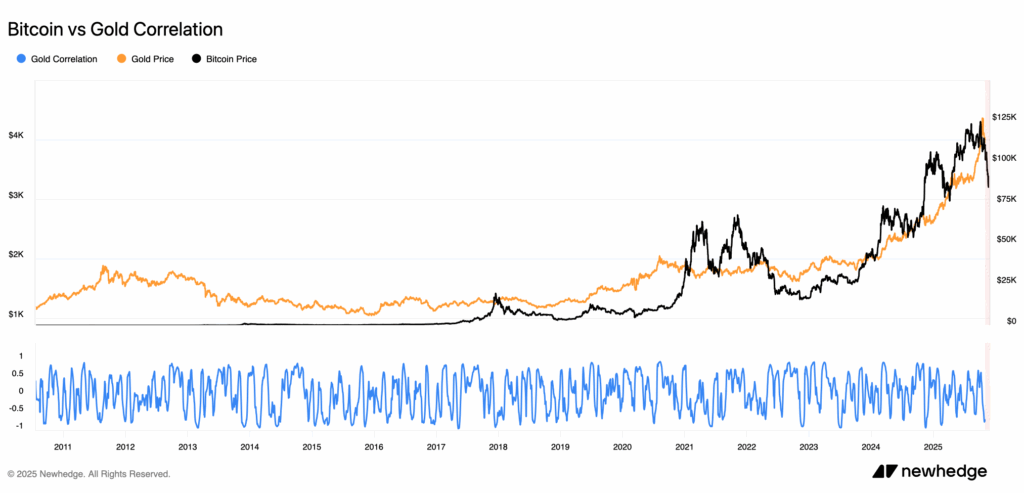
Bitcoin vs. gold correlation (Image: Newhedge)
Its characteristics—digital scarcity, global transferability, low transportation costs, and independence from national currency regimes—reinforce this role in an increasingly fragmented global economy. Price fluctuations do not change this structural character; rather, they are an expression of a young asset undergoing a complex transition process.
The Importance of Long-term Strategies in Monetary Transformation
In a phase of profound monetary change, it is risky to focus exclusively on short-term chart patterns or historical calendar cycles. Those who attempt to tactically time every market move often find themselves up against market participants with significantly greater capital and longer-term horizons.
A long-term perspective does not take into account fluctuations in individual weeks or months, but analyzes systemic developments: the increase in government debt, the decline in real interest rates, the ongoing digitalization of economic processes, and the global search for stable investments.
In addition, the issue of custody is becoming increasingly important. Those who operate exclusively through central service providers remain dependent on their rules and risks. The increasing migration of large portfolios to more stable forms of custody shows that a long-term investment horizon also requires robust ownership structures.
Outlook for the Rest of the Cycle
Recent developments point less to the end of a cycle than to a transition phase. The fundamental signs indicate a convergence of several trends: structural tensions in the global debt system, the increasing importance of digital assets, growing institutional participation, and macroeconomic conditions that tend to be expansionary in the medium term.
Bitcoin is therefore not in a final overheating phase, but in a complex market environment characterized by liquidity, which is causing significant shifts in ownership structures. The actual revaluation could only begin when the macroeconomic momentum turns sustainably and global liquidity enters a new phase of expansion.
What’s your Reaction?
+1
1

+1
0

+1
0

+1
0

+1
0

+1
0

+1
0