
Barely a year old, the decentralized exchange has gone from newcomer to challenger in the fiercely competitive derivatives space.
On September 17, Aster officially launched its token $ASTER, followed by a listing on Binance Alpha just a day later. The debut has already created waves. Within 24 hours of its token generation event (TGE), $ASTER surged 1,650% at peak, driving $310 million in trading volume and helping the platform cross $1.5 billion in total transactions.
#ASTER Token Skyrockets 9,900% Post-CZ Endorsement.
Launched at just $0.02 during its token generation event (TGE) on September 17, 2025, Aster stunned traders by climbing to $2 within four days.
This rapid surge of 9,900% briefly pushed its market capitalization to $3.3… pic.twitter.com/d6duFFUsuA
— TheCryptoBasic (@thecryptobasic) September 22, 2025
The launch was matched with a bold community initiative. Aster is allocating 53.5% of its total token supply toward one of the largest airdrops in DeFi, a move designed to reward early supporters and fuel momentum. Nearly 330,000 new wallets joined the network within a day, pushing total value locked (TVL) past $1 billion. The numbers alone show how quickly Aster has become a serious contender in an industry dominated by heavyweight Hyperliquid.
1/📊 Deep Dive: $ASTER Tokenomics Analysis@aster_dex launched their $ASTER token on September 17, 2025, backed by @yzilabs with an initial market cap of $116M, surging to $1B in 24 hours.
👥 Community-focused allocation
🔥 Protocol revenue buybacks
📈 Competitive emission… pic.twitter.com/mVATD9FjCC— Tokenomist (@Tokenomist_ai) September 19, 2025
What Makes Aster Different
Aster didn’t appear overnight. It was born from the merger of Astherus, a multi-asset liquidity protocol, and APX Finance, a perpetuals trading platform. With backing from YZi Labs, formerly known as Binance Labs, Aster entered the market with strong credibility. Since then, it has processed over $500 billion in cumulative trading volume, amassed 1.8 million user addresses, and generated $49 million in revenue.
YZi Labs 2024–25 Investments
The team formerly led by @CZ_binance continues its market expansion.
Backed by @yzilabs, @Aster_DEX is now the 4th perp DEX by volume and its $ASTER token surged 500%+ in the last few days.
Let’s take a closer look at recent YZi Labs’ investments👇 pic.twitter.com/krCN5inRMA
— CryptoRank.io (@CryptoRank_io) September 19, 2025
Its edge lies in innovation. Aster runs across multiple chains, including Ethereum, BNB Chain, Arbitrum, and Solana, offering broad accessibility. It has also introduced privacy orders that conceal traders’ positions, a rare feature in decentralized trading. Costs are low, too. With millisecond trade execution and zero gas fees, Aster competes directly with centralized exchanges on speed and affordability.
People keep calling $ASTER a Hyperliquid clone.
That’s how you know they haven’t done the homework lol.$ASTER is the blueprint for the next major DEX.
🧵 Let me show you why $ASTER below $1 is the kind of entry you only get once. pic.twitter.com/hQJp16eWp2
— Henry (@LordOfAlts) September 22, 2025
Beyond crypto, Aster also pushes boundaries by offering perpetual contracts tied to U.S. stocks like Tesla and Apple. This “stock perpetuals” product allows traders to gain exposure around the clock without relying on traditional brokers. To enhance security and reliability, Aster integrates with the Pyth Network for accurate price feeds.
New Instant Market Listing: $ASTER
You can now trade @Aster_DEX on dYdX with up to 5x leverage!
Get started ➡️ https://t.co/9CPdG4WgqV pic.twitter.com/5B5WOZvdoa
— dYdX (@dYdX) September 22, 2025
The Road Ahead
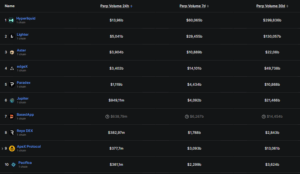
The decentralized derivatives market has grown rapidly, reaching nearly $630 billion in monthly trading volume this past August, according to DeFiLlama.
Source: DeFiLlama
While Hyperliquid still dominates, Aster’s explosive growth has raised the question of whether it could become the next leader. Its mix of strong ecosystem support, innovative features, and competitive fees makes it well-positioned to gain more market share.

Disclaimer
The information discussed by Altcoin Buzz is not financial advice. This is for educational, entertainment, and informational purposes only. Any information or strategies presented are the thoughts and opinions of the writer/reviewers, and their risk tolerance may differ from yours. We are not responsible for any losses you may incur due to any investments directly or indirectly related to the information provided. Bitcoin and other cryptocurrencies are high-risk investments; therefore, please conduct your due diligence. Copyright Altcoin Buzz Pte Ltd.
The post Why Aster Can Be the next Hyperliquid? appeared first on Altcoin Buzz.