
In recent days, the crypto markets have experienced one of the sharpest slumps in years. Bitcoin lost up to 20 percent of its value within a few hours, triggering a chain reaction on the stock markets. This resulted in liquidations in the double-digit billion range – a magnitude last seen during the COVID crash in 2020 or the collapse of the FTX exchange.
Within 24 hours, more than one million traders were liquidated and around $20 billion in leveraged positions were forcibly closed out. Such market movements show how strongly the crypto sector remains characterized by short-term speculation and high leverage, despite growing institutional presence.
Trigger: Geopolitical Escalation and Macroeconomic Pressure
The price decline was not isolated, but closely related to political events. A new level of escalation in the trade conflict between the US and China triggered nervousness on global financial markets. The US government announced massive tariff increases and export controls on critical technologies after China had previously restricted exports of rare earths.
These developments hit markets that were already tense: the S&P 500 lost around 2.7 percent in a single day, representing a decline of more than $1.5 trillion in market capitalization. The simultaneous correction in stocks and crypto shows that Bitcoin is increasingly perceived as a risk asset that is sensitive to geopolitical and macroeconomic uncertainties.
The Mechanism of Liquidations
A key factor in the abrupt slump was the high use of leveraged products. Many traders bet on short-term price increases, often with leverage of ten or more. Even moderate declines led to automatic liquidations.
Once a certain loss limit is reached, positions are forcibly closed to ensure the security of the platforms. These automatic sales create additional selling pressure, leading to a self-reinforcing downward spiral.
Altcoins were particularly affected, with their open trading volume (open interest) falling by around 40 percent in a short period of time. Open interest in Bitcoin itself also fell by around 24 percent. This correction points to a significant deleveraging of the market – a painful process in the short term, but a healthy one in the long term.
Market Structure and Technical Analysis
Despite the sharp correction, the longer-term market structure remains stable. On a weekly and monthly basis, the upward trend in Bitcoin remains intact.
Important technical markers are around $111,500 as the central support line and $95,000 as a possible last line of defense. As long as the price closes above the former zone, the overall trend is considered intact.
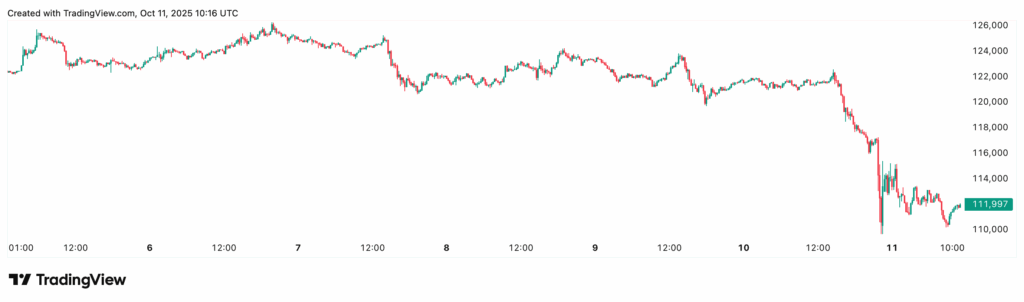
Chart analysis also shows that many of the panic sales were only temporary spikes (“wicks”) – rapid, deep movements caused by liquidations, but not necessarily marking a structural trend reversal.
Market Psychology and Investor Behavior
Emotional reactions play a decisive role in phases of high volatility. Fear and greed alternate in extreme market phases and lead to irrational decisions.
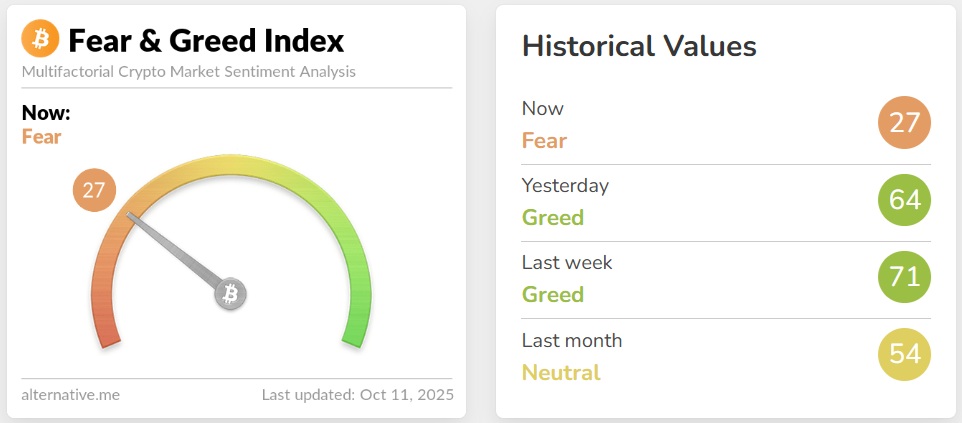
While short-term traders are often surprised by panic selling, experienced investors specifically use such phases to buy more. This is especially true in the spot market, where assets are held without leverage. This strategy is based on the assumption that extreme sell-offs are often exaggerated market reactions that will be corrected in the medium term.
Long-term Significance of the Correction
As painful as liquidation phases are, they fulfill a central function for market stability. They reduce overheating, remove excessive leverage from the market, and create the basis for more sustainable price formation.
Historically, such corrections have often been followed by new upward movements, as the market structure was more robust and less speculative afterwards.
A parallel can be found in previous cycles: after the COVID crash in 2020 and the FTX collapse in 2022, the market consolidated for several months before new upward phases began.
Outlook: Between Risk and Recovery
Whether the current decline marks the end of the bull run or is just a temporary correction depends on several factors: geopolitical developments, central bank decisions, market liquidity, and the behavior of institutional investors.
Deleveraging could trigger further volatility in the short term, but in the medium term it could create a healthy basis for stabilization and renewed growth. It remains crucial that investors adjust their risk management – through clear stop-loss limits, conservative leverage, and staggered purchase levels.
Discipline instead of Panic
The current crash illustrates the central lesson of crypto trading: volatility is not an exceptional situation, but part of the system. Only those who act with a rational view, clear strategies, and realistic risk management can be successful in the long term.
Short-term losses, triggered liquidations, or emotional shocks are not a new phenomenon in the history of Bitcoin – they do not mark the end, but often the beginning of a new market phase.
Conclusion
The slump in the S&P 500 following the announcement of new US tariffs against China shows how closely traditional financial markets and the crypto market are now intertwined. Within minutes, risky assets lost value globally, and Bitcoin reacted almost simultaneously with a massive sell-off. This synchronous movement illustrates that crypto is no longer an isolated ecosystem, but has become part of the global liquidity cycle. Macroeconomic shocks, geopolitical tensions, and monetary policy expectations now have a direct impact on Bitcoin, Ethereum, and the like. Those who operate in the crypto market must therefore not only read charts, but also understand global political dynamics, because in an era of algorithmic markets, a single tweet can wipe out trillions in market capitalization.
Author
Ed Prinz serves as chairman of https://dltaustria.com, Austria’s most renowned non-profit organization specializing in blockchain technology. DLT Austria is actively involved in educating and promoting the added value and application possibilities of distributed ledger technology. This is done through educational events, meetups, workshops, and open discussion rounds, all in voluntary collaboration with leading industry players.
Disclaimer
This is my personal opinion and not financial advice.
For this reason, I cannot guarantee the accuracy of the information in this article. If you are unsure, you should consult a qualified advisor you trust. This article does not make any guarantees or promises regarding profits. All statements in this and other articles are my personal opinion.
What’s your Reaction?
+1
0

+1
0

+1
0

+1
0

+1
0

+1
0

+1
0